Published and sources checked 2 November 2026. Prepared by Mayura Global Traders. This guide supports buying discussions; confirm the final specification and destination requirements for your shipment.
QUICK ANSWER
What should buyers check before importing moringa powder?
Specify Moringa oleifera leaf powder, its intended use, particle size, agreed moisture and microbiological limits, contaminant testing and packaging. Evaluate a representative sample and a batch-linked certificate of analysis before approving supply. Green colour, an organic claim or a low price alone does not establish quality.
Moringa powder can be an ingredient for food blends and other permitted applications, but buying it well starts with a precise product brief. This guide helps importers, ingredient distributors and manufacturers compare offers from India and identify the evidence to request.
Define the plant, plant part and intended use
Write the botanical name, Moringa oleifera, and the plant part on the purchase specification. Leaf powder, seed powder, extracts and blended preparations are different products. Ask whether the offer is milled dried leaves only or contains stems, carriers or other ingredients. A description such as “moringa powder” is too broad for a purchase order.
Explain whether your business will use the powder in a food formulation, repack it for retail or process it further. The intended use affects the evidence and destination checks needed. Do not assume that acceptance for one application or country establishes acceptance for another. Review proposed nutrition or health claims separately from ingredient procurement.
Ask how the leaves become powder
Request a process description covering raw-material selection, cleaning, drying, milling, sieving and packing. Ask where the leaves were grown and where the final powder was processed; those can be different locations. Identify the production lot and the system used to trace it back to incoming material.
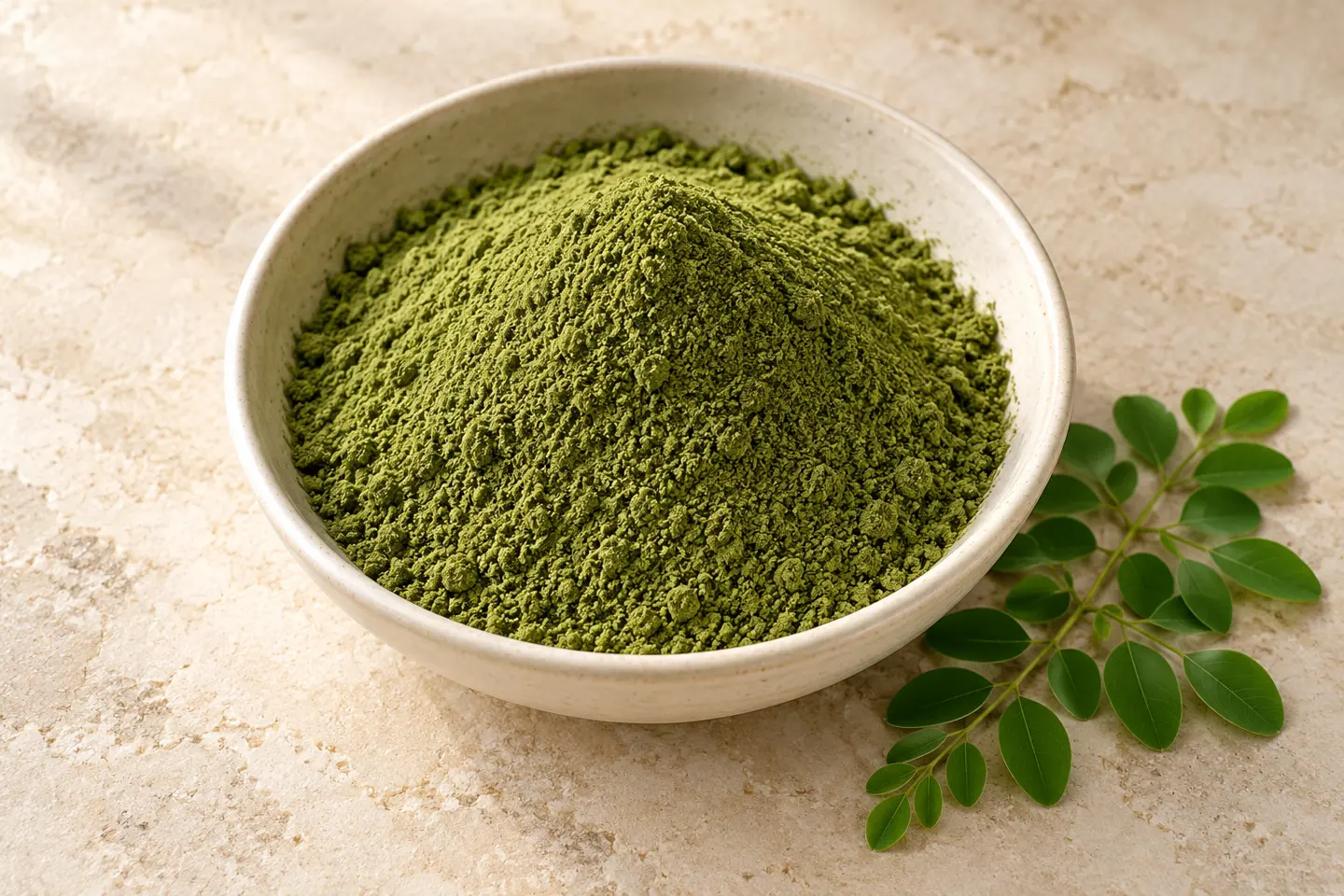
For sample approval, record colour, aroma, texture and visible foreign material under consistent conditions. Compare the sample in your intended formulation as well as dry. A very fine powder may perform differently from a coarser grade during blending or dispersion. Agree the sieve method and particle-size result rather than relying only on a marketing term such as “premium.”
Build a specification that can be checked
| Parameter | What to agree | What to request |
|---|---|---|
| Identity and composition | Species, leaf material and full ingredient declaration | Product specification and traceability information |
| Particle size | Sieve opening, test method and percentage passing | Result for a representative sample |
| Moisture and water activity | Separate limits where needed, with units and methods | Dated results linked to the proposed batch |
| Microbiological quality | Organisms, sampling plan and acceptance criteria for the end use | Laboratory report and relevant process-control evidence |
| Chemical contaminants | Destination-specific pesticide and contaminant panel | Results with reporting limits suitable for that market |
| Packing and shelf life | Pack size, barrier material, storage conditions and minimum remaining life | Pack details and the basis for the declared shelf life |
These are fields to agree, not universal numerical grades. Have your quality team set acceptance limits for the actual use and destination. If comparing two laboratories, check that their methods, units and sampling basis match. A number without that context can be misleading.
Use batch evidence, not appearance alone
A certificate of analysis should identify the product, batch, sampling or testing date, methods, results and acceptance criteria. Check that the report corresponds to the offered lot. A sample report from a previous shipment can show a reporting format but cannot establish the condition of the next delivery.
Drying does not make a powder sterile. The FAO/WHO review of low-moisture foods explains that bacteria can persist in dry products. For a powder used without a later effective kill step, discuss pathogen controls and post-process handling with your technical team. Finished-product testing supports a control programme; it does not replace it.
Check market access and certification requirements
CBI’s moringa market-entry guidance highlights traceability, pesticide residues, contaminants and differences between food and supplement uses in Europe. Use it as background, then ask the importer to verify current rules for the exact species, plant part, product form and intended use.
For the United States, FDA’s food-import guidance covers applicable facility registration and prior notice. The importer should also determine its Foreign Supplier Verification Program obligations. FDA registration is not approval of an individual product or shipment.
If certified organic supply is required, ask for a valid certificate covering the relevant operator, activity and product, plus any consignment documentation the destination requires. Verify other requested certifications in the same way. Do not infer organic, halal or food-safety certification from a product photograph or the word “natural.” Availability must be confirmed for the proposed supply.
Agree packaging, storage and shipment documents
Specify a food-contact pack suitable for the powder, its required moisture barrier, sealed inner lining, outer protection and net weight. Ask the supplier to state storage conditions and supported shelf life in that packaging. Set a minimum remaining shelf life at dispatch or arrival and define which milestone applies.
Review proposed labels and shipping marks before packing: product identity, lot, net weight, manufacturer or packer details and date information should match the transaction documents. Coordinate the invoice, packing list, transport document and origin documentation with the importer. Confirm whether any additional health, inspection or plant-health document is required for this processed product; requirements are shipment-specific.
Prepare a useful moringa powder enquiry
Send the quantity, intended application, destination country and port, desired delivery window, particle-size requirement and packing format. Include your test panel and certification requirements. Ask for the offered specification, sample arrangements, minimum order quantity, lead time and the named place or port for the quoted Incoterm.
Our moringa powder product page lists HSN 12119029 as the catalogue reference. Have the customs broker confirm classification for the exact goods and destination before shipment. Compare the full Dehydrated food powders range when preparing a multi-product quotation.
Common moringa powder buying questions
Does a bright green colour prove good quality?
No. Evaluate colour alongside identity, processing, sensory checks and appropriate laboratory evidence. Colour alone does not demonstrate safety or purity.
What mesh size should I request?
Choose it through a trial in your formulation. State a sieve opening and percentage passing so the buyer and supplier can reproduce the assessment.
Can I request organic moringa powder?
Yes. Include the required certification system and destination in the enquiry; availability and certificate scope need confirmation before purchase.
Prepared by Mayura Global Traders. Sources reviewed 2 November 2026. Editorial, sources and corrections policy.
PLAN YOUR NEXT SHIPMENT
Request a specification-based quotation.
Send the product, quantity, packing requirements and destination to Mayura Global Traders in Bengaluru, Karnataka, India. We aim to respond within one business day.
Build your quotationContact our sourcing team